

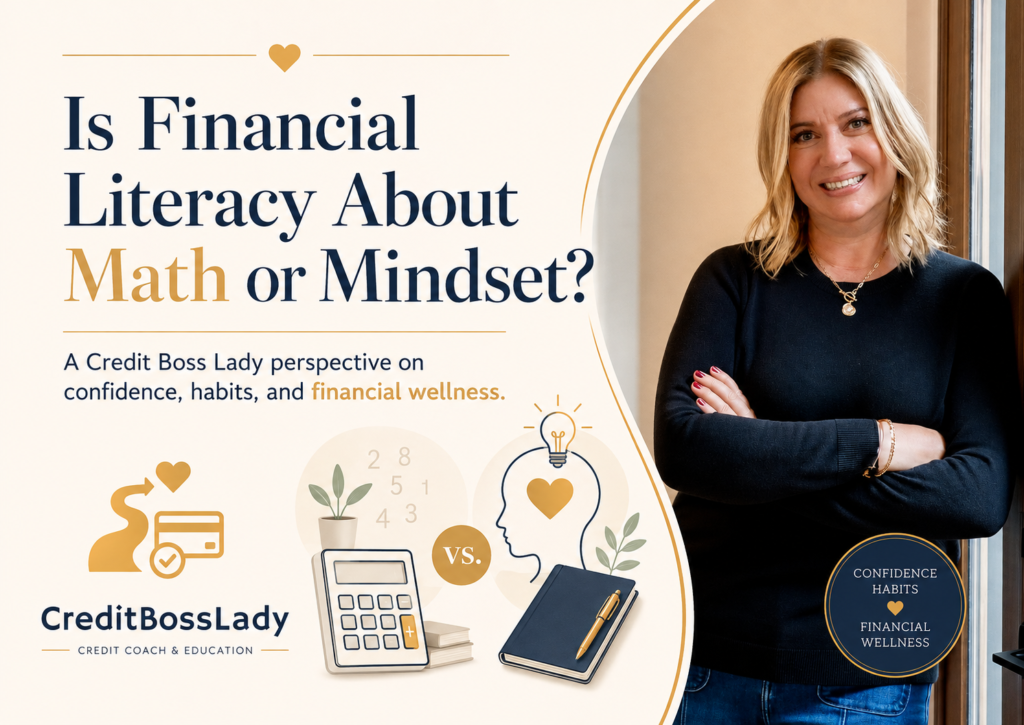
Knowing what to do with your money and actually doing it are two different skills. Only one of them is math.
I can usually tell the moment it is about to happen.
Someone is ready to check their credit report. They have the login. They have the time. And then they do not do it.
Not because they cannot. Because they are afraid of what they will see.
We have spent years treating financial literacy like an information problem. Know your score. Understand interest rates. Build a budget. Pay on time. Save more, spend less.
All of that is true. None of it explains the pause.
After years of working with people around credit and financial health, I have learned that knowledge is rarely the only thing standing in the way. You can know exactly what you should do with your money and still not do it.
Money is not only math. It is memory, fear, habit, and shame — and none of those respond to a spreadsheet.
I see it in the hesitation before someone checks a credit report, opens a banking app, looks at a debt balance, or sits down to build a budget. There is real anxiety attached to simply looking.
What if the number is worse than I thought?
What if I made a mistake?
What if I do not know how to fix it?
I understand that feeling, because I used to be that person.
I know what financial avoidance feels like from the inside
There was a time when I was driving a beat-up car to late-night waitressing shifts and there was a stack of bills on my counter I would not touch.
When collectors called, I let the phone ring.
I was a single mom trying to be present for my daughter, and dealing with the financial mess in front of me felt scary and overwhelming.
So I avoided it.
I told myself that if I could just get through today, tomorrow would somehow be easier.
Tomorrow never showed up on its own.
Here is what I eventually learned:
Avoidance does not make a financial problem smaller. It just gives the problem more time to grow.
The day I finally sat down and looked was not the day my finances got better. It was the day they stopped getting worse.
That turned out to be the more important day.
It took courage to look — and a little audacity to ask the questions I had been too embarrassed to ask. Once I did both, my relationship with money began to change.
I stopped reading the numbers as a verdict on who I was and started using them as information I could act on.
That shift is the reason I do this work. Everything I learned in those years became the blueprint I now share with my clients and my community.
The real problem usually is not knowledge
When someone tells me, “I’m just bad with money,” I do not reach for another how-to course.
I want to know what is underneath that sentence.
So I ask:
Does thinking about money make you want to change the subject?
Are you afraid to look at your credit report?
Do you spend more when you are stressed?
Do you carry shame about a decision you made years ago?
Have you built budgets so strict that no real person could follow them?
Take a few minutes with those questions. Do not overthink them, and do not grade yourself. Write down the first answer that comes to mind.
Whatever you wrote down is the actual work.
Financial behavior is human behavior, and human behavior always has a reason behind it.
A budget shows you where your money went. It cannot tell you why you keep making the same choice.
A credit score reports your history. It has nothing to say about how you feel about that history, and the feeling is often what drives the next decision.
That gap, between what people know and what people actually do, is where financial literacy and psychology meet.
Start smaller than you think you should
Financial progress does not require a financial makeover.
Sometimes the first step is opening the app you have been avoiding and looking at one number.
Not fixing it.
Not building a plan around it.
Just looking at it long enough to understand what it is telling you.
Then you decide what, if anything, you want to do about it.
That is a complete first step.
You are allowed to stop there today.
Confidence does not come from one perfect budget or from the resolution you make every January.
It comes from small moments of looking and acting, repeated until looking stops feeling dangerous.
That is what I wanted the Credit Boss Lady App to make possible.
Tools and education around credit, budgeting, debt, and financial planning that you can use on your own time, in your own home, without having to walk into a conversation already knowing all the answers.
A place to start that does not ask you to be ready first.
Because financial education should not add to anyone’s shame. It should replace shame with information, and information is something you can act on.
So, math or mindset?
The math matters, and it always will.
But after all these years, I have never once seen someone’s numbers change before the person did.
Understanding the numbers is only half of financial literacy.
Understanding the person reading them is the half we too often skip.
Stay connected with Jeanne for more credit tips
- Download the Credit Boss Lady App
- Follow me on Instagram: @creditjeanne
- Listen to the podcast: Credit Over Coffee
- Check out more resources: jeannekelly.net
